


Musical Instruments Market : Global Industry Analysis and Opportunity Assessment, 2036
The Musical Instruments Market is segmented by Product (String Instruments, Keyboard Instruments, Wind Instruments, Percussion Instruments), Application (Professional, Educational Use, Personal Entertainment), End Use (Individual, Institutional Buyers, Commercial Buyers), Material, End User Industry, and Region. Forecast for 2026 to 2036.
- Market Size (2026): USD 14.4 Bn
- Forecast (2036): USD 22.1 Bn
- CAGR (2026 to 2036): 4.4%
Musical Instrument Market Size, Market Forecast and Outlook By FMI
The musical instruments market size stood at USD 13.8 billion in 2025. Industry revenue is projected to reach USD 14.4 billion in 2026 and rise to USD 22.1 billion by 2036 at 4.4% CAGR. Individual users are expected to account for 60.0% share of end use in 2026. Wood-based materials are expected to account for 55.0% share of material in 2026.
Summary of Musical Instruments Market
- Demand and Growth Drivers
- Music learning keeps entry instruments visible as students need affordable first products with stable service.
- Live entertainment supports repeat orders for guitars and keyboards used in regular performances.
- Home recording lifts digital keyboard and electronic drum interest through simple software connection.
- Product and Segment View
- Individual users are projected to account for 60.0% share in 2026, driven by students and hobby players driving unit volume.
- Wood based materials are expected to capture 55.0% share in 2026, influenced by strong demand for tonewood in guitars and pianos.
- Professional applications are forecast to represent 51.0% share in 2026 due to stage and studio use.
- Geography and Competitive Outlook
- GCC demand is set to record 6.2% CAGR by 2036, reflected by entertainment venues and cultural programs influencing purchase.
- Japan demand is expected to expand at 5.6% CAGR by 2036 as domestic makers support digital pianos and keyboards.
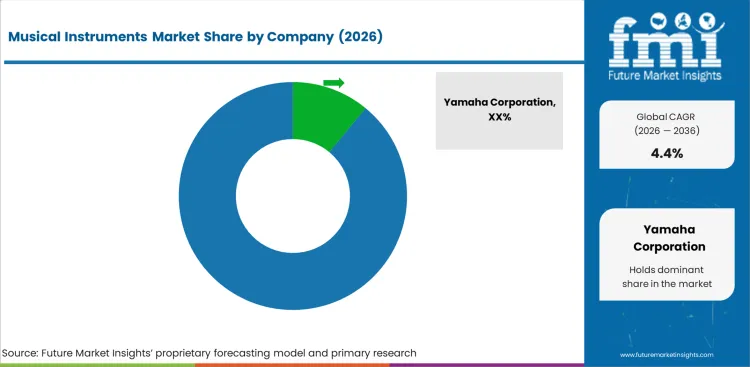
- Yamaha Corporation and Fender Musical Instruments Corporation anchor competition through broad catalogs and dealer reach.
- Analyst Opinion
- Rahul Pandita, Principal Consultant at FMI, says, “Musical instrument suppliers win by matching product feel with channel trust. Entry buyers need easy learning and fair pricing. Professional users pay for sound consistency and service support. Instruments also need to hold value after years of use.”
- Musical Instruments Market Value Analysis
- Musical instruments value is shifting from basic acoustic products toward digital keyboards and hybrid instruments with recording support.
- Manufacturer spending is tied to sound quality and material stability as learners and professional users expect longer product life.
- Suppliers are linking instrument value with brand trust and channel reach as online lessons increase entry-level purchases.
- Demand is supported by schools and entertainment users seeking reliable instruments for learning and studio work.
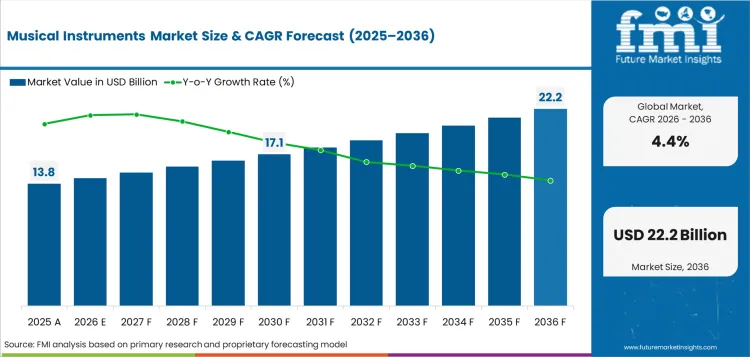
Supplier planning faces a sharper split between trade visibility and digital feature depth. In 2025, Music China stated its exhibition covered 140,000 sq m and drew 114,283 visitors from 121 countries and regions. Such trade reach makes China a larger sourcing and product testing venue for keyboards, strings and percussion. In 2025, Korg’s multi/poly specification listed 37 semi weighted keys and 60 voice maximum polyphony. Higher polyphony gives synthesizer suppliers a clearer case for premium sound design and studio use. In 2025, C.F. Martin stated it recycled over 114 tons of wood scrap and 43.6 tons of cardboard. Waste reuse gives acoustic guitar makers measurable proof for material discipline. Retailers can use such proof to support premium guitars without relying only on brand heritage.
Musical Instruments Market Definition
Musical instruments are products used to produce sound for learning and performance. Use also covers worship and content creation. Scope covers acoustic instruments and digital instruments sold to households and educators. Venues and studios are counted under commercial use. Accessories are counted only as part of an instrument package or clear replacement need. Recorded music devices and generic audio hardware without instrument function are excluded.
Musical Instruments Market Inclusions
Scope includes guitars and violins. Pianos, digital keyboards and workstations are counted as well. Brass instruments and woodwinds are included. Drums and hand percussion are counted. Professional stage instruments and studio instruments are covered. School instruments and private lesson instruments are included. Religious and cultural instruments are counted through formal retail or institutional channels.
Musical Instruments Market Exclusions
Scope excludes speakers and microphones sold without an instrument function. Headphones and recording equipment are excluded under the same rule. Music software without hardware is excluded. Toy instruments are excluded if they are not designed for actual performance or learning. Repair services are counted only with instrument replacement or sale.
Musical Instruments Market Research Methodology
- Primary Research: FMI analysts reviewed buying needs across music retailers and educators. Stage users and instrument distributors were checked separately.
- Desk Research: Trade data, association data and official company releases supported market checks and supplier mapping.
- Market Sizing and Forecasting: Forecast values were reconciled against trade checks and category allocation. Segment shares reflected buyer use and product mix.
- Data Validation: Checks compared 2026 value with 2036 value and tested CAGR consistency. Country rates were reviewed against trade and music activity signals.
Why is the Musical Instruments Market Growing?
- Music learning is widening entry-level purchases for guitars and keyboards through school programs and online retail.
- Professional use is raising replacement need for instruments maintaining tone during stage and studio work.
- Digital practice tools are increasing demand for keyboards and electronic percussion linked to lessons and home recording.
Growth outlook is steady because instrument purchases have two clear routes, learning use and active music making. In January 2025, the National Center for Education Statistics reported that 84.0% of United States public schools offered standalone music classes during the 2024 to 2025 school year. The same release found that 55.0% of school leaders viewed support for arts instruction as adequate, including funding and instruments. Another 21.0% said support was inadequate for arts instruction across public schools during the same reporting cycle. This gap points to replacement and upgrade need for school instruments beyond new learner demand. National Endowment for the Arts reported in October 2024, 16.3% of United States adults created or performed art in the prior month during its April to July 2024 survey. The same brief reported that 25.0% attended a live in-person performance or art exhibit in the prior month. Together, these indicators support demand for starter instruments and mid-range upgrades across guitars and percussion.
Market Segmentation Analysis
- String instruments are forecast to capture 45.0% share in 2026 led by guitars and bowed instruments serving learning and paid performance.
- Professional applications are projected to account for 51.0% share in 2026 due to stage and studio users buying for dependable tone.
- Individual users are expected to represent 60.0% share in 2026, influenced by hobby players and students accounting for broad unit movement.
- Wood based materials are projected to hold 55.0% share in 2026 as tonewood cues stay important across guitars and pianos.
- Entertainment is anticipated to account for 50.0% share in 2026 since live shows and media work require reliable instruments.
Segmentation is divided into five parent groups based on how instruments are bought and specified. Product separates instrument families used in learning and performance. Application shows whether instruments are used for professional work or education. End use separates individual buyers from institutions and commercial venues. Material and end user industry explain why tone, durability and usage context shape pricing.
Insights into Musical Instruments Market by Product
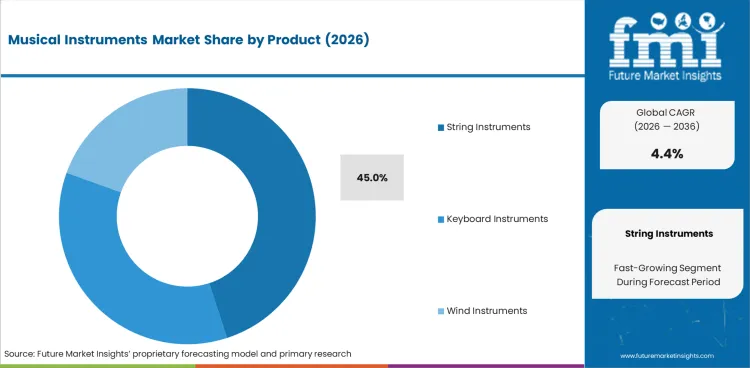
- String instruments are projected to account for 45.0% share in 2026, influenced by guitars offering a wide price ladder from starter packs to professional models.
- Keyboard instruments keep value through digital piano upgrades and workstation demand. Portable models serve home practice and music lessons.
Insights into Musical Instruments Market by Application
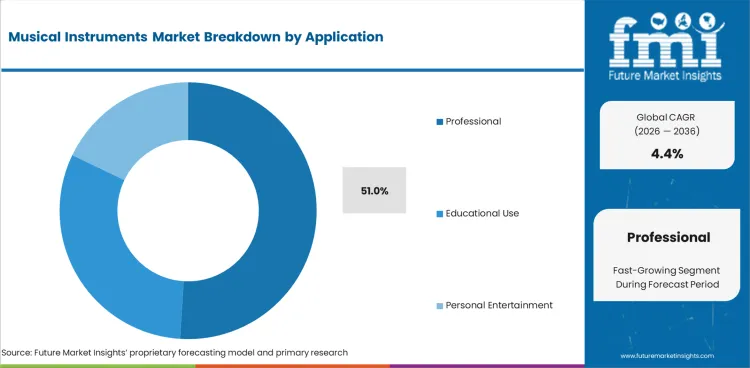
- Professional applications are expected to represent 51.0% share in 2026, led by performers and studio users requiring dependable tone under repeated use.
- Educational use creates steady volume through schools and practice-at-home programs. Products must be durable and simple to maintain as students often handle instruments daily.
Insights into Musical Instruments Market by End Use
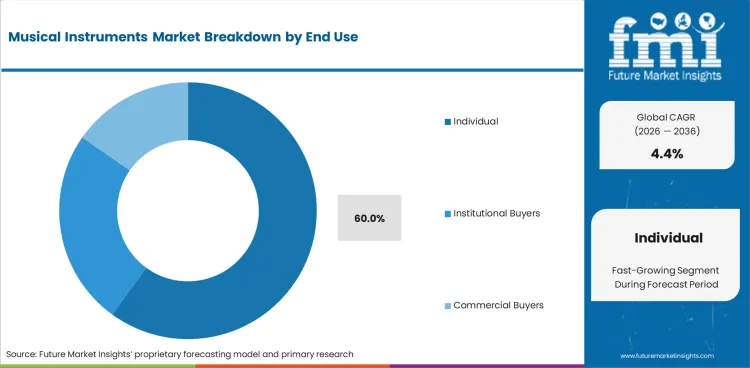
- Individual users are forecast to account for 60.0% share in 2026, driven by students and hobby players buying across price bands.
- Institutional buyers include schools and colleges requiring serviceable instruments for repeated student use. Order timing often follows academic budgets and curriculum changes.
Insights into Musical Instruments Market by Material
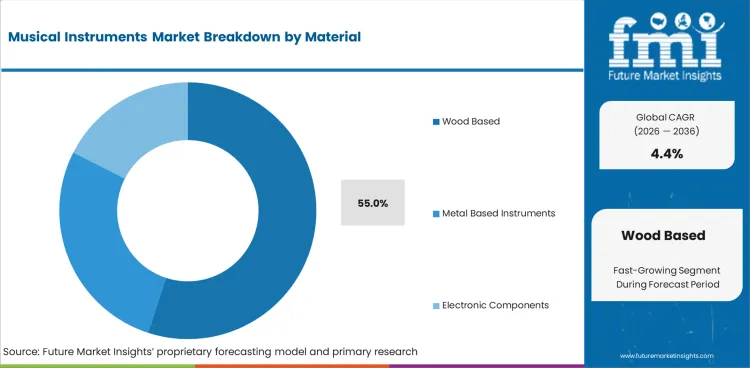
- Wood based materials are anticipated to represent 55.0% share in 2026 since acoustic identity stays central for guitars and pianos.
- Metal based instruments serve brass and percussion frames. Material selection affects weight and repair life in school and stage use.
Insights into Musical Instruments Market by End User Industry
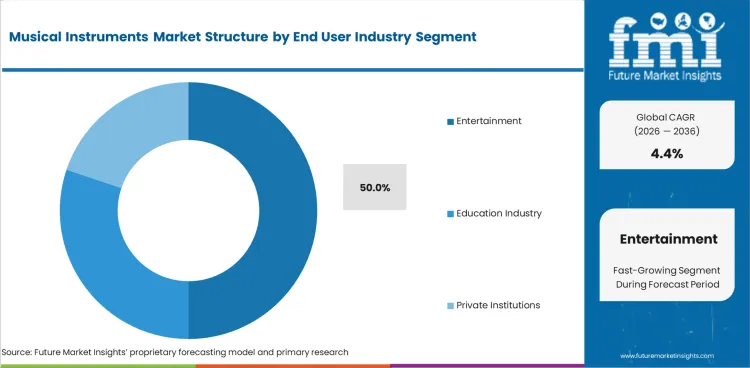
- Entertainment is projected to account for 50.0% share in 2026 as live shows and media production need reliable instruments.
- Education industry demand is tied to schools and private training. Products need clear learning value and repair paths reducing downtime.
Musical Instruments Market Drivers, Restraints and Opportunities
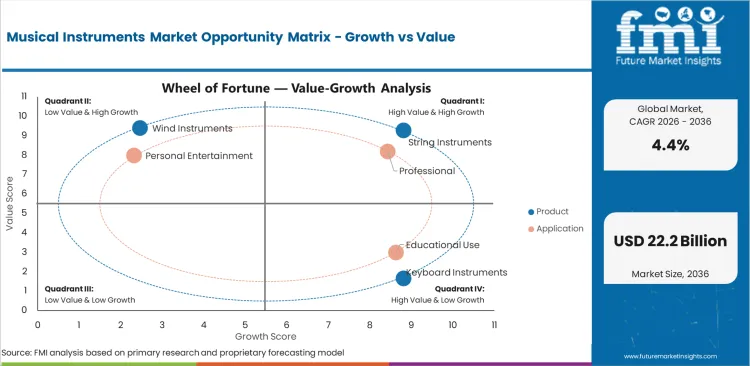
- Learning and practice purchases are supporting starter guitars and keyboards through schools and home learning.
- Instrument affordability and regulated tonewood materials can slow upgrades for beginners and touring musicians.
- Digital practice features create upgrade room for keyboards and electronic percussion used in home recording.
Learning remains the main volume route with the outlook still depending on affordability and digital support. ABRSM reported in April 2025, 74.0% of people who learn an instrument started before age 12. Cost is the restraint to watch as 29.0% of children who do not learn music cited tuition cost as the main barrier. Material rules add another limit for premium acoustic instruments. United States Department of Agriculture guidance from January 2026 says instruments containing Brazilian rosewood and other protected materials can face entry controls under protected species rules. CITES means the Convention on International Trade in Endangered Species of Wild Fauna and Flora. Digital learning creates the clearest opportunity since 43.0% of children used YouTube and 30.0% used apps for music learning. Future sales will favor suppliers pairing affordable starter products with credible tone and simple digital learning features.
Technology Adoption and Automation Penetration Analysis
Technology adoption in musical instruments is moving through digital sound engines and hybrid instruments. Factory process control is becoming more relevant over heavy distributed control systems. Yamaha’s fiscal 2026 plan lists musical instruments revenue at ¥304.9 billion and core operating profit at ¥21.2 billion. Same briefing says digital musical instrument sales increased due to strong reception of new products. Forward demand will favor suppliers using sensors and process controls to improve assembly precision. Machine vision and connected controls will contribute most in finish checks and product consistency. Machine vision and connected controls will contribute most in inspection and finish consistency.
Application-wise Equipment Deployment Analysis
Equipment use should be framed around learning and performance. Home creation forms a third path for compact keyboards and electronic percussion. ABRSM’s 2025 survey covered 1,021 children and 1,011 adults. It also included 1,958 music teachers. It found 69% of children currently play or previously played an instrument, and 85% of music learners practice on piano or keyboard. It also reported 89% of schools offer extracurricular musical activities. Figures point to school and home practice as the main equipment routes. Professional equipment demand should track paid performance and studio use, while education should favor durable instruments with repair access.
Analysis of Musical Instruments Market by Key Countries
.webp "Top Country Growth Comparison Musical Instruments Market Cagr (2026 2036)")
| Country | CAGR |
|---|---|
| GCC | 6.2% |
| Japan | 5.6% |
| Brazil | 4.1% |
| United Kingdom | 3.7% |
| Germany | 3.5% |
| China | 3.4% |
| United States | 3.1% |
Source: Future Market Insights, 2026.
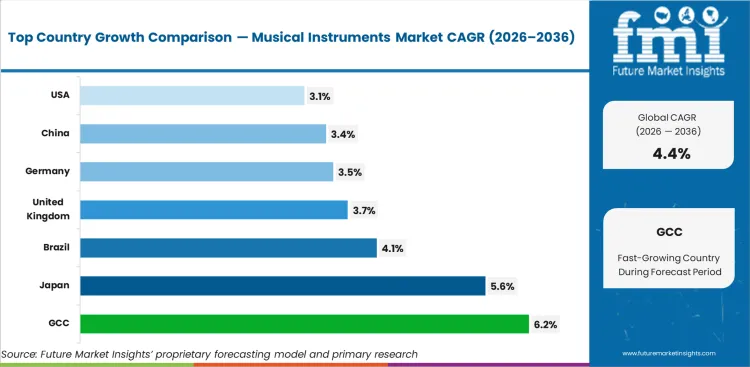
Musical Instruments Market CAGR Analysis by Country
- GCC is projected to rise at 6.2% CAGR by 2036, led by entertainment activity and cultural venues lifting instrument purchases.
- Japan is expected to expand at 5.6% CAGR by 2036 since domestic makers strengthen digital pianos and compact keyboards.
- Brazil is expected to post 4.1% CAGR by 2036 as music consumption and import channels support mid-range instruments.
- United Kingdom is expected to expand at 3.7% CAGR by 2036, influenced by live music and exports promoting performer spending.
- Germany is forecast to grow at 3.5% CAGR by 2036 as European trade depth supports electronic instruments and professional products.
- China is forecast at 3.4% CAGR by 2036 as export scale anchors supply and domestic learning demand stays broad.
- United States is projected to record 3.1% CAGR by 2036, driven by mature retail channels and import dependence keeping growth measured.
Country performance varies by income and live entertainment activity. GCC and Japan track above the global rate due to venue growth and strong digital instrument supply. United States and Germany grow at measured rates as replacement and upgrade buying account for most value. Brazil and China keep a positive path through youth participation and broad retail access.
Industry Outlook for Musical Instruments in GCC
GCC demand is projected to rise at 6.2% CAGR by 2036, reflected by entertainment venues and cultural programs widening purchase occasions. International Federation of the Phonographic Industry reported in March 2025, Middle East and North Africa recorded music revenue rose 22.8% in 2024. Streaming accounted for 99.5% of regional recorded music revenue. Digital engagement gives instrument sellers a larger pool of creators and performers.
- Entertainment venues support demand for stage keyboards and guitars used in live shows.
- Cultural programs encourage traditional music participation and group performance equipment purchases.
- Digital music activity raises interest in instruments connecting to home studio and mobile tools.
Growth Outlook for Musical Instruments in Japan
Musical instrument demand in Japan is expected to expand at 5.6% CAGR by 2036, influenced by domestic makers supporting digital pianos and compact keyboards. World Integrated Trade Solution recorded Japan HS 920790 imports at USD 91.9 million and 445,197 items in 2024. Local brand depth keeps buyers attentive to touch and sound accuracy. Domestic innovation supports higher-value models for home practice.
- Digital pianos benefit from smaller homes requiring compact instruments with low-noise practice options.
- Brand trust supports keyboard and piano upgrades from student models into higher-value home instruments.
- Imported electronic instruments expand choice for creators using desktop recording and lesson apps.
Sales Analysis of Musical Instruments in Brazil
Sales in Brazil are expected to post 4.1% CAGR by 2036 since music participation and import channels support mid-range products. World Integrated Trade Solution recorded Brazil HS 920790 imports at USD 17.7 million and 194,586 items in 2024. Import channels are smaller than in North America and Europe. Retail value can rise as buyers move toward better keyboards and guitars.
- Guitar demand benefits from strong popular music culture and wide use in home practice.
- Electronic keyboards support worship and small performance needs in price-sensitive channels.
- Retailers need financing options and reliable repair service to convert interest into higher-value purchases.
Demand Analysis of Musical Instruments in the United Kingdom
Demand in the United Kingdom is expected to expand at 3.7% CAGR by 2036 due to live music and creative work influencing instrument buying. UK Music reported in November 2025, United Kingdom music contributed GBP 8.0 billion in gross value added during 2024. Exports reached GBP 4.8 billion in the same year. Creator income and live activity give instrument retailers a wider professional user pool.
- Live music activity supports keyboards and percussion used across small venues and touring acts.
- Creator exports keep professional instruments visible across studios and rehearsal spaces.
- Retailers benefit from learners moving from school programs into personal instrument ownership.
Sales Outlook for Musical Instruments in Germany
Sales in Germany are forecast to grow at 3.5% CAGR by 2036, led by trade depth supporting both professional and student instruments. World Integrated Trade Solution recorded Germany HS 920790 imports at USD 169.2 million and 447,905 items in 2024. German buyers often compare build quality and service access before purchase. Such behavior favors brands with clear warranties and dealer support.
- Professional users favor instruments with stable tuning and clear repair access after heavy use.
- School and private lessons support demand for wind instruments and starter guitars.
- Cross-border European trade gives retailers a broad range of electronic models and accessories.
Demand Outlook for Musical Instruments in China
Sector in China is forecast at 3.4% CAGR by 2036 as export scale and domestic learning demand keep the industry active. World Integrated Trade Solution recorded China HS 920790 exports at USD 339.3 million and 4.6 million items in 2024. Such export depth supports price coverage across entry electronic instruments. Domestic brands can gain value by improving quality control and after-sale service.
- Large export volume gives Chinese makers cost advantage in keyboards and amplified instruments.
- Music learning supports starter instruments through schools and household purchases.
- Premium growth depends on brand trust and better service beyond low-price product supply.
Demand Outlook for Musical Instruments in the United States
Demand in the United States is projected to record 3.1% CAGR by 2036, as mature retail channels support replacement more than first-time penetration. World Integrated Trade Solution recorded United States HS 920790 imports at USD 364.1 million and 2.2 million items in 2024. Import depth shows a wide electronic instrument retail channel. Premium brands will rely on dealer setup and service to defend value against low-cost supply.
- Guitar and keyboard replacement supports value as experienced players trade up to better sound and construction.
- School and worship channels keep dependable mid-priced instruments visible across local dealer networks.
- Import reliance makes pricing sensitive to freight costs and policy changes affecting electronic instruments.
Competitive Landscape and Strategic Positioning
- Diversified makers hold an advantage led by catalogs covering student instruments and digital models.
- Guitar specialists stand out based on playability and dealer setup across entry and premium price bands.
- Piano specialists build value through acoustic heritage and digital hybrid models designed for home practice.
Competition in the musical instruments market is led by broadline manufacturers and piano-focused suppliers. Such companies compete on dealer reach and service support across learning and home practice needs. Yamaha Corporation and Roland Corporation compete across keyboards and professional equipment. Fender Musical Instruments Corporation and Gibson Brands hold strong guitar identities. Steinway and Sons and Kawai Musical Instruments Manufacturing focus on piano trust and touch quality. Casio Computer adds depth in digital pianos and portable keyboards.
Supplier choice depends on product feel and resale confidence. Smaller firms can compete depending on popular instruments or artist ties. Large retailers favor brands with stable supply and clear warranties. Companies supporting first-time learners and professional upgrades are likely to gain repeat business. Firms with trusted dealer networks and credible digital lines are best placed to win.
Key Companies in the Musical Instruments Market
Competitive structure is differentiated by diversified instrument makers, guitar specialists and piano specialists.
- Diversified Instrument Makers: Yamaha Corporation, Roland Corporation and Casio Computer Co. Ltd. supply digital keyboards, pianos and electronic music products.
- Guitar Specialists: Fender Musical Instruments Corporation, Gibson Brands Inc. and C. F. Martin and Co. Inc. compete through electric and acoustic guitar depth.
- Piano Specialists: Steinway and Sons, Kawai Musical Instruments Manufacturing Co. Ltd. and Guangzhou Pearl River Piano Group Co. Ltd. support acoustic and digital piano demand.
Competitive Benchmarking: Musical Instruments Market
| Company | Category Breadth | Dealer Channel Fit | Digital Instrument Depth | Geographic Footprint |
|---|---|---|---|---|
| Yamaha Corporation | High | Strong | Strong | Japan and global |
| Fender Musical Instruments Corporation | Medium | Strong | Medium | United States and global |
| Gibson Brands Inc. | Medium | Strong | Low | United States and global |
| Roland Corporation | High | Strong | High | Japan and global |
| Kawai Musical Instruments Manufacturing Co. Ltd. | Medium | Strong | Medium | Japan and global |
| Casio Computer Co. Ltd. | Medium | Strong | High | Japan and Asia |
| Guangzhou Pearl River Piano Group Co. Ltd. | Medium | Medium | Low | China and export |
Source: Future Market Insights competitive analysis 2026. Ratings reflect relative positioning based on category coverage, dealer presence and digital instrument depth.
Key Developments in Musical Instruments Market
- In March 2025, Roland Corporation announced GO:PIANO88 with 88 full-size keys and app-linked learning tools.
- In August 2025, Kawai Musical Instruments Manufacturing Co. Ltd. announced CX102 and CX202 digital pianos for affordable home practice.
- In October 2025, Fender Musical Instruments Corporation announced the American Professional Classic series for its modern electric guitar lineup.
Key Players in the Musical Instruments Market
Major Global Players:
- Yamaha Corporation
- Fender Musical Instruments Corporation
- Gibson Brands Inc.
- Roland Corporation
- Steinway and Sons
- Kawai Musical Instruments Manufacturing Co. Ltd.
- Casio Computer Co. Ltd.
Specialist and Regional Players:
- Guangzhou Pearl River Piano Group Co. Ltd.
- C. F. Martin and Co. Inc.
- Eastman Music Company
Market Report Scope
| Parameter | Details |
|---|---|
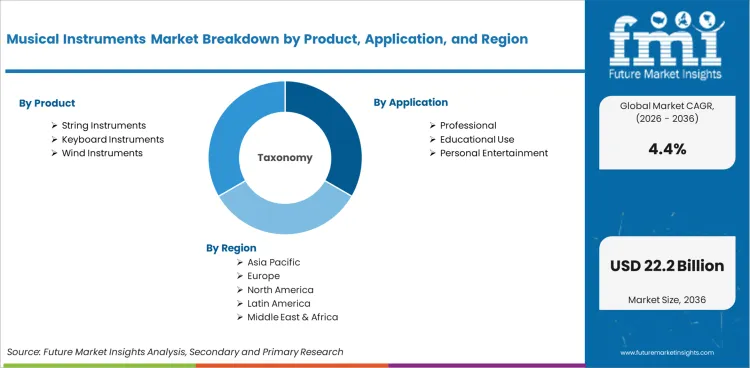
| Quantitative Units | USD 14.4 billion to USD 22.1 billion, at 4.4% CAGR |
| Market Definition | Functional acoustic and electronic instruments used for learning, performance, worship and content creation |
| Product | String instruments, keyboard instruments, wind instruments, percussion instruments |
| Application | Professional, educational use, personal entertainment |
| End use | Individual, institutional buyers, commercial buyers |
| Material | Wood based, metal-based instruments, electronic components, hybrid materials |
| End user industry | Entertainment, education industry, private institutions, religious and cultural institutions |
| Regions covered | North America, Europe, East Asia, Latin America, Middle East and Africa |
| Countries covered | United States, United Kingdom, Germany, Japan, GCC, China, Brazil |
| Key companies profiled | Yamaha, Fender, Gibson, Roland, Steinway and Sons, Kawai, Casio, Pearl River Piano Group, C. F. Martin, Eastman |
| Forecast period | 2026 to 2036 |
| Approach | Hybrid top-down and bottom-up model with trade checks and supplier mapping |
Source: Future Market Insights, 2026.
Musical Instruments Market Breakdown by Product, Application, End Use, Material, End User Industry, and Region
By Product:
- String Instruments
- Keyboard Instruments
- Wind Instruments
- Percussion Instruments
By Application:
- Professional
- Educational Use
- Personal Entertainment
By End Use:
- Individual
- Institutional Buyers
- Commercial Buyers
By Material:
- Wood Based
- Metal Based Instruments
- Electronic Components
- Hybrid Materials
By End User Industry:
- Entertainment
- Education Industry
- Private Institutions
- Religious and Cultural Institutions
By Region:
- North America
- Latin America
- Europe
- East Asia
- South Asia and Pacific
- Middle East and Africa
Research Sources and Bibliography
- National Center for Education Statistics. (2025, January 22). More than a quarter of public schools now offer all students free school meals through state or local initiatives. USA Department of Education, Institute of Education Sciences.
- National Endowment for the Arts. (2024, October 31). New research explores arts engagement and social connectedness.
- ABRSM. (2025, April). Making music research series: Playing, learning and teaching music in the UK 2025: Extending our ambition for music education in the UK.
- Animal and Plant Health Inspection Service. (2026, January 13). International traveler: Musical instruments. USA Department of Agriculture.
- Yamaha Corporation. (2026, May 11). Analyst and investor briefing on FY2026.3: Fiscal year ended March 31, 2026.
- Casio Computer Co. Ltd. (2024, January 25). Casio to release digital piano with the rich expressiveness of a grand piano.
- Fender Musical Instruments Corporation. (2025, October 14). Fender expands American Professional series.
- International Federation of the Phonographic Industry. (2025, March 19). Global recorded music revenues grew 4.8% in 2024.
- Kawai Musical Instruments Manufacturing Co. Ltd. (2025, August 21). Kawai announces new CX102 and CX202 digital pianos.
- National Association of Music Merchants. (2024, August 14). Industry insights from the 2024 NAMM global report.
- National Association of Music Merchants. (2025, January 29). The 2025 NAMM Show unites the global music industry with world’s largest global gathering.
- Roland Corporation. (2025, March 18). Roland announces GO:PIANO88 digital piano.
- UK Music. (2025, November 12). This is music 2025.
- World Integrated Trade Solution. (2026, May 21). China musical instrument exports by country in 2024.
- World Integrated Trade Solution. (2026, May 21). Musical instrument imports by country in 2024.
- Music China. (2026). Overview.
- Korg Inc. (2025, January 16). multi/poly Owner’s Manual (English). Korg.
- C.F. Martin & Co. (2025). Sustainability.
Bibliography uses official association and multilateral trade sources issued from 2024 onward.
This Report Answers
- What is the expected value of musical instruments market by 2036?
- What CAGR is forecast for musical instruments market from 2026 to 2036?
- Which product type is projected to account for a leading share in 2026?
- Which application is expected to hold a leading share of musical instruments demand?
- How do material choices affect musical instrument supplier selection?
- Which countries are forecast to record stronger growth by 2036?
- Which companies compete in musical instruments market?
- How do education and entertainment applications affect market value?
- What methodology supports the musical instruments market forecast?
Frequently Asked Questions
What is the musical instruments market value in 2026?
The musical instruments market value is estimated at USD 14.4 billion in 2026.
What is the expected value of musical instruments market by 2036?
The musical instruments industry revenue is forecast to reach USD 22.1 billion by 2036 as learning and performance use continue.
What CAGR is expected for musical instruments market?
The musical instruments sector is projected to expand at 4.4% CAGR from 2026 to 2036 with steady replacement demand.
Which product segment holds a leading share in musical instruments market?
String instruments are expected to account for 45.0% share in 2026 due to guitars and orchestral instrument use.
Which application is prominent in musical instruments market?
Professional applications are projected to account for 51.0% share in 2026 as stage and studio users need dependable tone.
Which country or region grows faster in musical instruments market?
GCC is projected to record 6.2% CAGR by 2036, led by venues and cultural programs supporting instrument purchases.
What are musical instruments?
Musical instruments are acoustic or electronic products used to create sound for learning and performance. Worship and content creation are covered as well.
How is the musical instruments market forecast prepared?
Forecasting uses market values and segment shares. Country rates and trade checks refine regional exposure and product mix.
Why do wood-based materials lead musical instruments market?
Wood based materials lead as guitars and pianos depend on tone and finish quality for buyer confidence.
Do digital instruments reduce acoustic instrument demand?
Digital instruments expand practice options but do not replace acoustic demand where tone and tradition drive selection.
Who uses musical instruments?
Students and hobby players use musical instruments at home. Performers and studios buy for regular practice and paid work.
How long do musical instruments last?
Instrument life depends on material and the frequency of it being used. Quality guitars and pianos often support many years of use.
Are premium musical instruments better than entry instruments?
Premium instruments offer better tone and service life for experienced users. Entry instruments remain useful for new learners.
Table of Content
- Executive Summary
- Global Market Outlook
- Demand-side Trends
- Supply-side Trends
- Technology Roadmap Analysis
- Analysis and Recommendations
- Market Overview
- Market Coverage / Taxonomy
- Market Definition / Scope / Limitations
- Research Methodology
- Chapter Orientation
- Analytical Lens and Working Hypotheses
- Market Structure, Signals, and Trend Drivers
- Benchmarking and Cross-market Comparability
- Market Sizing, Forecasting, and Opportunity Mapping
- Research Design and Evidence Framework
- Desk Research Programme (Secondary Evidence)
- Company Annual and Sustainability Reports
- Peer-reviewed Journals and Academic Literature
- Corporate Websites, Product Literature, and Technical Notes
- Earnings Decks and Investor Briefings
- Statutory Filings and Regulatory Disclosures
- Technical White Papers and Standards Notes
- Trade Journals, Industry Magazines, and Analyst Briefs
- Conference Proceedings, Webinars, and Seminar Materials
- Government Statistics Portals and Public Data Releases
- Press Releases and Reputable Media Coverage
- Specialist Newsletters and Curated Briefings
- Sector Databases and Reference Repositories
- FMI Internal Proprietary Databases and Historical Market Datasets
- Subscription Datasets and Paid Sources
- Social Channels, Communities, and Digital Listening Inputs
- Additional Desk Sources
- Expert Input and Fieldwork (Primary Evidence)
- Primary Modes
- Qualitative Interviews and Expert Elicitation
- Quantitative Surveys and Structured Data Capture
- Blended Approach
- Why Primary Evidence is Used
- Field Techniques
- Interviews
- Surveys
- Focus Groups
- Observational and In-context Research
- Social and Community Interactions
- Stakeholder Universe Engaged
- C-suite Leaders
- Board Members
- Presidents and Vice Presidents
- R&D and Innovation Heads
- Technical Specialists
- Domain Subject-matter Experts
- Scientists
- Physicians and Other Healthcare Professionals
- Governance, Ethics, and Data Stewardship
- Research Ethics
- Data Integrity and Handling
- Primary Modes
- Tooling, Models, and Reference Databases
- Desk Research Programme (Secondary Evidence)
- Data Engineering and Model Build
- Data Acquisition and Ingestion
- Cleaning, Normalisation, and Verification
- Synthesis, Triangulation, and Analysis
- Quality Assurance and Audit Trail
- Market Background
- Market Dynamics
- Drivers
- Restraints
- Opportunity
- Trends
- Scenario Forecast
- Demand in Optimistic Scenario
- Demand in Likely Scenario
- Demand in Conservative Scenario
- Opportunity Map Analysis
- Product Life Cycle Analysis
- Supply Chain Analysis
- Investment Feasibility Matrix
- Value Chain Analysis
- PESTLE and Porter’s Analysis
- Regulatory Landscape
- Regional Parent Market Outlook
- Production and Consumption Statistics
- Import and Export Statistics
- Market Dynamics
- Global Market Analysis 2021 to 2025 and Forecast, 2026 to 2036
- Historical Market Size Value (USD Million) Analysis, 2021 to 2025
- Current and Future Market Size Value (USD Million) Projections, 2026 to 2036
- Y-o-Y Growth Trend Analysis
- Absolute $ Opportunity Analysis
- Global Market Pricing Analysis 2021 to 2025 and Forecast 2026 to 2036
- Global Market Analysis 2021 to 2025 and Forecast 2026 to 2036, By Product
- Introduction / Key Findings
- Historical Market Size Value (USD Million) Analysis By Product , 2021 to 2025
- Current and Future Market Size Value (USD Million) Analysis and Forecast By Product , 2026 to 2036
- String Instruments
- Keyboard Instruments
- Wind Instruments
- String Instruments
- Y-o-Y Growth Trend Analysis By Product , 2021 to 2025
- Absolute $ Opportunity Analysis By Product , 2026 to 2036
- Global Market Analysis 2021 to 2025 and Forecast 2026 to 2036, By Application
- Introduction / Key Findings
- Historical Market Size Value (USD Million) Analysis By Application, 2021 to 2025
- Current and Future Market Size Value (USD Million) Analysis and Forecast By Application, 2026 to 2036
- Professional
- Educational Use
- Personal Entertainment
- Professional
- Y-o-Y Growth Trend Analysis By Application, 2021 to 2025
- Absolute $ Opportunity Analysis By Application, 2026 to 2036
- Global Market Analysis 2021 to 2025 and Forecast 2026 to 2036, By End Use
- Introduction / Key Findings
- Historical Market Size Value (USD Million) Analysis By End Use, 2021 to 2025
- Current and Future Market Size Value (USD Million) Analysis and Forecast By End Use, 2026 to 2036
- Individual
- Institutional Buyers
- Commercial Buyers
- Individual
- Y-o-Y Growth Trend Analysis By End Use, 2021 to 2025
- Absolute $ Opportunity Analysis By End Use, 2026 to 2036
- Global Market Analysis 2021 to 2025 and Forecast 2026 to 2036, By Material
- Introduction / Key Findings
- Historical Market Size Value (USD Million) Analysis By Material, 2021 to 2025
- Current and Future Market Size Value (USD Million) Analysis and Forecast By Material, 2026 to 2036
- Wood Based
- Metal Based Instruments
- Electronic Components
- Wood Based
- Y-o-Y Growth Trend Analysis By Material, 2021 to 2025
- Absolute $ Opportunity Analysis By Material, 2026 to 2036
- Global Market Analysis 2021 to 2025 and Forecast 2026 to 2036, By End User Industry
- Introduction / Key Findings
- Historical Market Size Value (USD Million) Analysis By End User Industry, 2021 to 2025
- Current and Future Market Size Value (USD Million) Analysis and Forecast By End User Industry, 2026 to 2036
- Entertainment
- Education Industry
- Private Institutions
- Entertainment
- Y-o-Y Growth Trend Analysis By End User Industry, 2021 to 2025
- Absolute $ Opportunity Analysis By End User Industry, 2026 to 2036
- Global Market Analysis 2021 to 2025 and Forecast 2026 to 2036, By Region
- Introduction
- Historical Market Size Value (USD Million) Analysis By Region, 2021 to 2025
- Current Market Size Value (USD Million) Analysis and Forecast By Region, 2026 to 2036
- North America
- Latin America
- Western Europe
- Eastern Europe
- East Asia
- South Asia and Pacific
- Middle East & Africa
- Market Attractiveness Analysis By Region
- North America Market Analysis 2021 to 2025 and Forecast 2026 to 2036, By Country
- Historical Market Size Value (USD Million) Trend Analysis By Market Taxonomy, 2021 to 2025
- Market Size Value (USD Million) Forecast By Market Taxonomy, 2026 to 2036
- By Country
- USA
- Canada
- Mexico
- By Product
- By Application
- By End Use
- By Material
- By End User Industry
- By Country
- Market Attractiveness Analysis
- By Country
- By Product
- By Application
- By End Use
- By Material
- By End User Industry
- Key Takeaways
- Latin America Market Analysis 2021 to 2025 and Forecast 2026 to 2036, By Country
- Historical Market Size Value (USD Million) Trend Analysis By Market Taxonomy, 2021 to 2025
- Market Size Value (USD Million) Forecast By Market Taxonomy, 2026 to 2036
- By Country
- Brazil
- Chile
- Rest of Latin America
- By Product
- By Application
- By End Use
- By Material
- By End User Industry
- By Country
- Market Attractiveness Analysis
- By Country
- By Product
- By Application
- By End Use
- By Material
- By End User Industry
- Key Takeaways
- Western Europe Market Analysis 2021 to 2025 and Forecast 2026 to 2036, By Country
- Historical Market Size Value (USD Million) Trend Analysis By Market Taxonomy, 2021 to 2025
- Market Size Value (USD Million) Forecast By Market Taxonomy, 2026 to 2036
- By Country
- Germany
- UK
- Italy
- Spain
- France
- Nordic
- BENELUX
- Rest of Western Europe
- By Product
- By Application
- By End Use
- By Material
- By End User Industry
- By Country
- Market Attractiveness Analysis
- By Country
- By Product
- By Application
- By End Use
- By Material
- By End User Industry
- Key Takeaways
- Eastern Europe Market Analysis 2021 to 2025 and Forecast 2026 to 2036, By Country
- Historical Market Size Value (USD Million) Trend Analysis By Market Taxonomy, 2021 to 2025
- Market Size Value (USD Million) Forecast By Market Taxonomy, 2026 to 2036
- By Country
- Russia
- Poland
- Hungary
- Balkan & Baltic
- Rest of Eastern Europe
- By Product
- By Application
- By End Use
- By Material
- By End User Industry
- By Country
- Market Attractiveness Analysis
- By Country
- By Product
- By Application
- By End Use
- By Material
- By End User Industry
- Key Takeaways
- East Asia Market Analysis 2021 to 2025 and Forecast 2026 to 2036, By Country
- Historical Market Size Value (USD Million) Trend Analysis By Market Taxonomy, 2021 to 2025
- Market Size Value (USD Million) Forecast By Market Taxonomy, 2026 to 2036
- By Country
- China
- Japan
- South Korea
- By Product
- By Application
- By End Use
- By Material
- By End User Industry
- By Country
- Market Attractiveness Analysis
- By Country
- By Product
- By Application
- By End Use
- By Material
- By End User Industry
- Key Takeaways
- South Asia and Pacific Market Analysis 2021 to 2025 and Forecast 2026 to 2036, By Country
- Historical Market Size Value (USD Million) Trend Analysis By Market Taxonomy, 2021 to 2025
- Market Size Value (USD Million) Forecast By Market Taxonomy, 2026 to 2036
- By Country
- India
- ASEAN
- Australia & New Zealand
- Rest of South Asia and Pacific
- By Product
- By Application
- By End Use
- By Material
- By End User Industry
- By Country
- Market Attractiveness Analysis
- By Country
- By Product
- By Application
- By End Use
- By Material
- By End User Industry
- Key Takeaways
- Middle East & Africa Market Analysis 2021 to 2025 and Forecast 2026 to 2036, By Country
- Historical Market Size Value (USD Million) Trend Analysis By Market Taxonomy, 2021 to 2025
- Market Size Value (USD Million) Forecast By Market Taxonomy, 2026 to 2036
- By Country
- Kingdom of Saudi Arabia
- Other GCC Countries
- Turkiye
- South Africa
- Other African Union
- Rest of Middle East & Africa
- By Product
- By Application
- By End Use
- By Material
- By End User Industry
- By Country
- Market Attractiveness Analysis
- By Country
- By Product
- By Application
- By End Use
- By Material
- By End User Industry
- Key Takeaways
- Key Countries Market Analysis
- USA
- Pricing Analysis
- Market Share Analysis, 2025
- By Product
- By Application
- By End Use
- By Material
- By End User Industry
- Canada
- Pricing Analysis
- Market Share Analysis, 2025
- By Product
- By Application
- By End Use
- By Material
- By End User Industry
- Mexico
- Pricing Analysis
- Market Share Analysis, 2025
- By Product
- By Application
- By End Use
- By Material
- By End User Industry
- Brazil
- Pricing Analysis
- Market Share Analysis, 2025
- By Product
- By Application
- By End Use
- By Material
- By End User Industry
- Chile
- Pricing Analysis
- Market Share Analysis, 2025
- By Product
- By Application
- By End Use
- By Material
- By End User Industry
- Germany
- Pricing Analysis
- Market Share Analysis, 2025
- By Product
- By Application
- By End Use
- By Material
- By End User Industry
- UK
- Pricing Analysis
- Market Share Analysis, 2025
- By Product
- By Application
- By End Use
- By Material
- By End User Industry
- Italy
- Pricing Analysis
- Market Share Analysis, 2025
- By Product
- By Application
- By End Use
- By Material
- By End User Industry
- Spain
- Pricing Analysis
- Market Share Analysis, 2025
- By Product
- By Application
- By End Use
- By Material
- By End User Industry
- France
- Pricing Analysis
- Market Share Analysis, 2025
- By Product
- By Application
- By End Use
- By Material
- By End User Industry
- India
- Pricing Analysis
- Market Share Analysis, 2025
- By Product
- By Application
- By End Use
- By Material
- By End User Industry
- ASEAN
- Pricing Analysis
- Market Share Analysis, 2025
- By Product
- By Application
- By End Use
- By Material
- By End User Industry
- Australia & New Zealand
- Pricing Analysis
- Market Share Analysis, 2025
- By Product
- By Application
- By End Use
- By Material
- By End User Industry
- China
- Pricing Analysis
- Market Share Analysis, 2025
- By Product
- By Application
- By End Use
- By Material
- By End User Industry
- Japan
- Pricing Analysis
- Market Share Analysis, 2025
- By Product
- By Application
- By End Use
- By Material
- By End User Industry
- South Korea
- Pricing Analysis
- Market Share Analysis, 2025
- By Product
- By Application
- By End Use
- By Material
- By End User Industry
- Russia
- Pricing Analysis
- Market Share Analysis, 2025
- By Product
- By Application
- By End Use
- By Material
- By End User Industry
- Poland
- Pricing Analysis
- Market Share Analysis, 2025
- By Product
- By Application
- By End Use
- By Material
- By End User Industry
- Hungary
- Pricing Analysis
- Market Share Analysis, 2025
- By Product
- By Application
- By End Use
- By Material
- By End User Industry
- Kingdom of Saudi Arabia
- Pricing Analysis
- Market Share Analysis, 2025
- By Product
- By Application
- By End Use
- By Material
- By End User Industry
- Turkiye
- Pricing Analysis
- Market Share Analysis, 2025
- By Product
- By Application
- By End Use
- By Material
- By End User Industry
- South Africa
- Pricing Analysis
- Market Share Analysis, 2025
- By Product
- By Application
- By End Use
- By Material
- By End User Industry
- USA
- Market Structure Analysis
- Competition Dashboard
- Competition Benchmarking
- Market Share Analysis of Top Players
- By Regional
- By Product
- By Application
- By End Use
- By Material
- By End User Industry
- Competition Analysis
- Competition Deep Dive
- Yamaha Corporation
- Overview
- Product Portfolio
- Profitability by Market Segments (Product/Age /Sales Channel/Region)
- Sales Footprint
- Strategy Overview
- Marketing Strategy
- Product Strategy
- Channel Strategy
- Fender Musical Instruments Corporation
- Gibson Brands Inc.
- Roland Corporation
- Steinway and Sons
- Yamaha Corporation
- Competition Deep Dive
- Assumptions & Acronyms Used


